At a glance guide to benefit uprating in April 2026

Rebecca McDonald Published on 01st April 2026

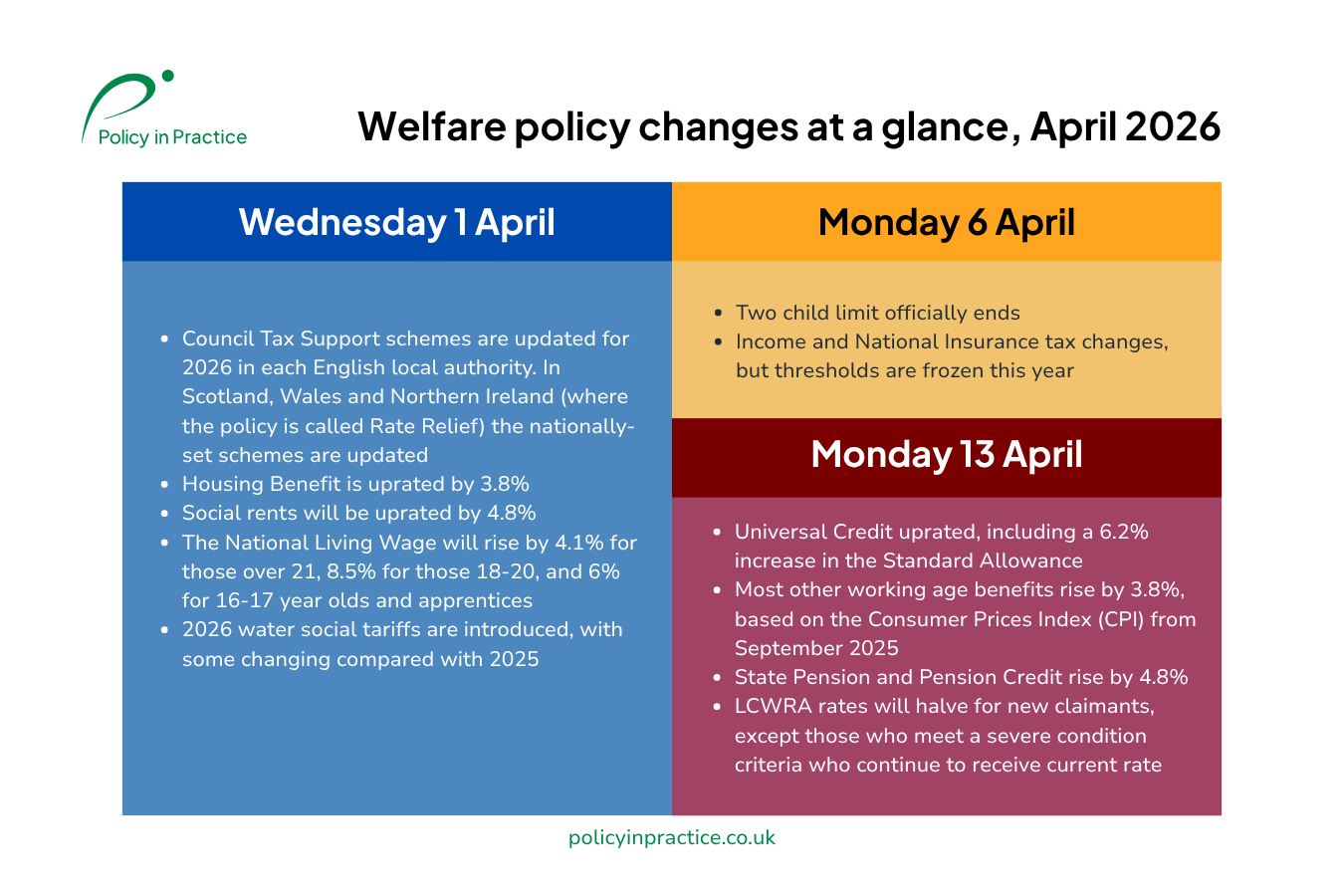
Today, Wednesday 1 April 2026, marks the start of welfare policy changes and awards. Here’s our at a glance guide to the headline benefit uprating changes taking place this year.
In April 2026, there are two contrasting stories to tell about benefit uprating
Some benefits are increasing more than usual, providing an above-inflation boost in incomes. Larger families are also benefiting significantly from the end of the child limit.
As global conflict ushers in a new wave of economic uncertainty, these gains will go some way to counteracting a rising cost of living.
At the same time, support for some families will be weakened by a lack of change this April. The freezes in the Local Housing Allowance (LHA) rate and the benefit cap will be particularly impactful, while changes to the health element of UC will halve awards for new claimants.
How each household is affected will depend on its collection of circumstances: family size, housing tenure, employment status, health status, among others.
Policy in Practice’s products are updated in real-time to maintain accuracy
For users of the Better Off Calculator, we’ll be making updates as they happen.
For LIFT users, dashboards for April (published in May) will reflect these policy changes.
Clients don’t have to do anything for the changes to be applied.
An above-inflation increase in benefits gives valuable support as a new cost of living shock looms
Most working age benefits will rise by 3.8% this year, linked to the inflation rate in September 2025.
In contrast, the Universal Credit standard allowance is increasing by 6.2% this year, a change brought in by the Universal Credit Act of 2025. This is the first of four years when upratings are committed to be above inflation. Pensioners will also benefit from a real-terms boost in support, as both the State Pension and Pension Credit rise by 4.8%.
These increases coincide with two other changes easing the pressure on low income families.
Low paid workers will see a boost in their earnings as the National Living Wage increases by 4.1% for those over 21, 8.5% for 18-19 year olds, and 6% for 16-17 year olds and apprentices. The £150 reduction in energy bills (on average) announced in Budget 2025 last November will also come into effect and be fed automatically through to our customers.
For other benefits, it is the lack of change that will significantly impact families this April
Not all benefit rates are increasing to account for inflation. The two most notable exceptions are Local Housing Allowance (LHA) and the Benefit Cap.
Keeping LHA rates the same this year will push the policy even further from achieving its objective of making housing affordable to those on low incomes. As support continues to diverge from private rents, more families will fall into rent arrears, and there will be additional pressure on the Crisis and Resilience Fund and local homelessness services.
The two child limit will now be removed
For the 17% of low income families with children who currently have their financial support capped by the policy, many will gain significantly from Monday 6 April 2026 as they receive additional child elements in their Universal Credit income.
While this is a welcome change, our analysis last November found that 1 in 5 of these larger families will not gain fully from the policy ending. Instead, they will find they are capped by a different policy: the overall benefit cap, some for the first time this year.
Long planned changes to the Limited Capability for Work Related Activity (LCRWA) element of Universal Credit are taking place
From Monday 6 April 2026, the LCWRA rate will halve from £423.27 a month to £217.26 for new claimants, except those with a life long severe condition.
However, existing claimants whose claims started before April 2026 will continue receiving the current rate of LCWRA, including an increase this month to adjust for inflation.
This will create a tiered system of support, based specifically on the claim date rather than an assessment of need.
2026 Council Tax Reduction (CTR) schemes will come into effect at the start of April, but many will not change significantly
A quarter of English councils are altering the support they offer, such as introducing an income banded scheme, while others are refraining from change for now.
The year ahead promises to be very disruptive for CTR policymaking: Local Government Reform will require councils to consolidate their schemes, council tax itself will be rebalanced to lower-income areas and there will be new requirements to protect vulnerable residents.
Listen back to our recent webinar or download our report exploring trends in CTR policymaking across the past five years.
April 2026 marks the end of legacy benefits and the completion of managed migration to Universal Credit
Legacy benefits, such as Tax Credits, the Employment and Support Allowance, and Job Seekers’ Allowance, will officially be retired this month. Anyone yet to migrate to Universal Credit will lose their support, so it’s a crucial time to help those still on legacy benefits to make the move.
Policy in Practice has been part of Universal Credit since its inception, and we recognise what a big shift this has been to the social security system and, more importantly, to the lives of people on means tested benefits.
While the roll out has been both challenging and disruptive, and largely framed by cuts to social security, the pandemic clearly showed how it is a better system on which to build than the legacy system it replaced.
In the face of the rising cost of living and fragmentation of local support, we are proud to be helping to deliver on one of Universal Credit’s core aims – to ensure people can access all of their support in one place.
Next steps
- Learn more about our Better Off Calculator
- Learn more about our LIFT platform
- Read impact stories from clients across local authorities, utilities, finance and housing sectors
Chat with us about how you can empower your clients using our software
By submitting this form I confirm that I have read the privacy policy and agree to the processing of my personal data by Policy in Practice for the stated purposes. I can revoke my consent to this processing at any time